Electrostatic Generator - The Triboelectric Effect
A slightly technical discussion
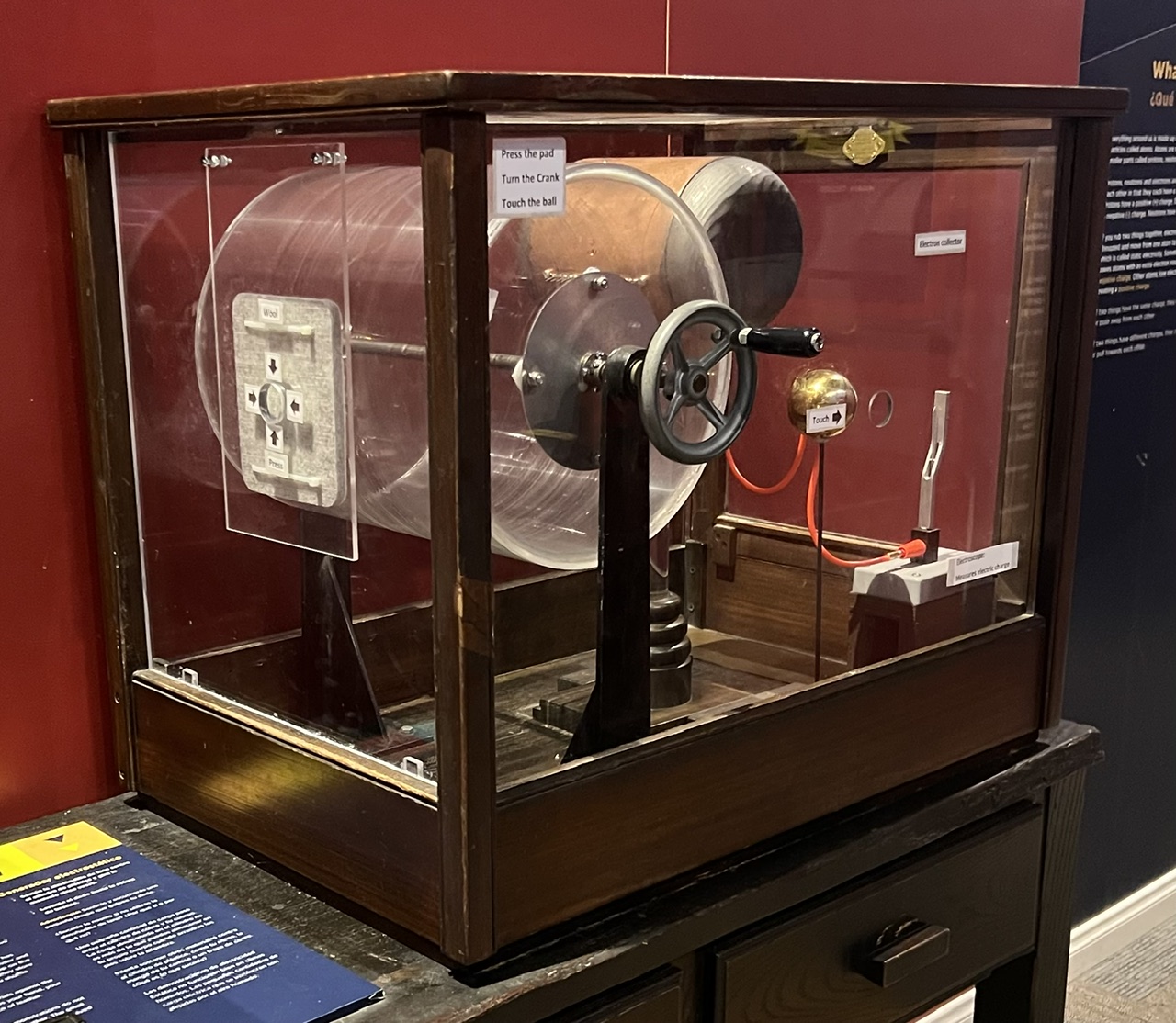 In this exhibit one can generate electric charge, collect that charge on a large metalic drum and connected metal ball, and dissipate that charge by putting a finger near the metal ball and receiving a mild electric shock. To generate the charge, a nylon pad is pressed against a rotating drum made of clear acrylic plastic. It turns out that when two dissimilar materials rub or contact each other, electrons may be transferred from one material to the other in a process known as the triboelectric effect. Different materials have different affinities for electrons and this determines the direction the electrons will be transferred and how strongly they will want to move.
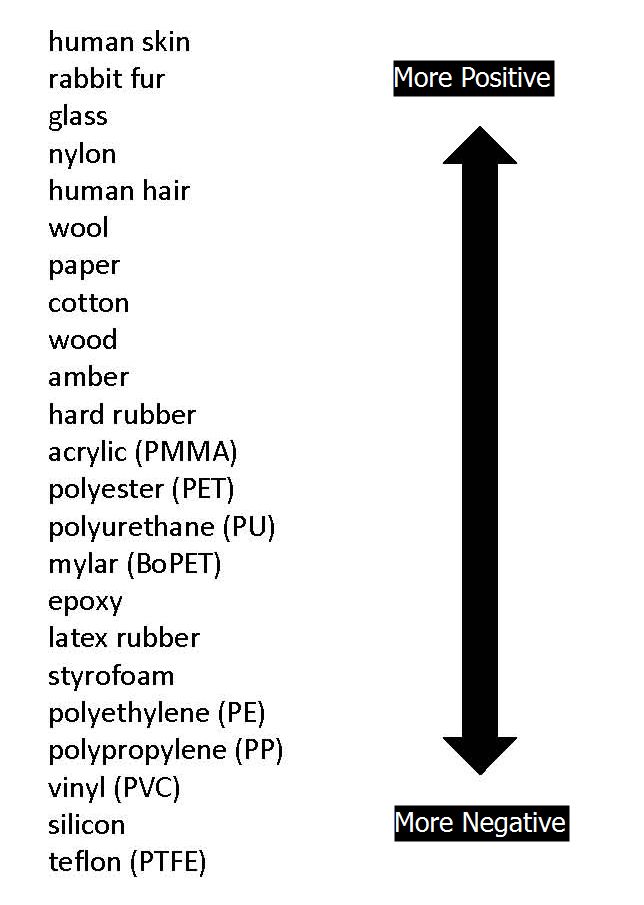 This can be seen in the triboelectric chart. The chart indicates that nylon is more positive than acrylic, and as a result, electrons (which are negative) will transfer from the nylon to the acrylic when the two are in contact. Increasing the separation on the chart (say by changing one of the materials) will typically increase the effect. Thus if the rotating drum was made of vinyl instead of acrylic one could expect a stronger effect. (Note: the photo shows the exhibit with a wool pad. It was recently changed to nylon because of maintenence problems with the wool.)
The acrylic drum sits next to another drum, one made mostly of copper (a conductor). The gray endcaps are wood painted with conductive paint and thus form a part of this "electron collector." Acrylic does not conduct electricity, so electrons that are deposited on the surface of the rotating drum will simply stay there until given an opportunity to go somewhere else.
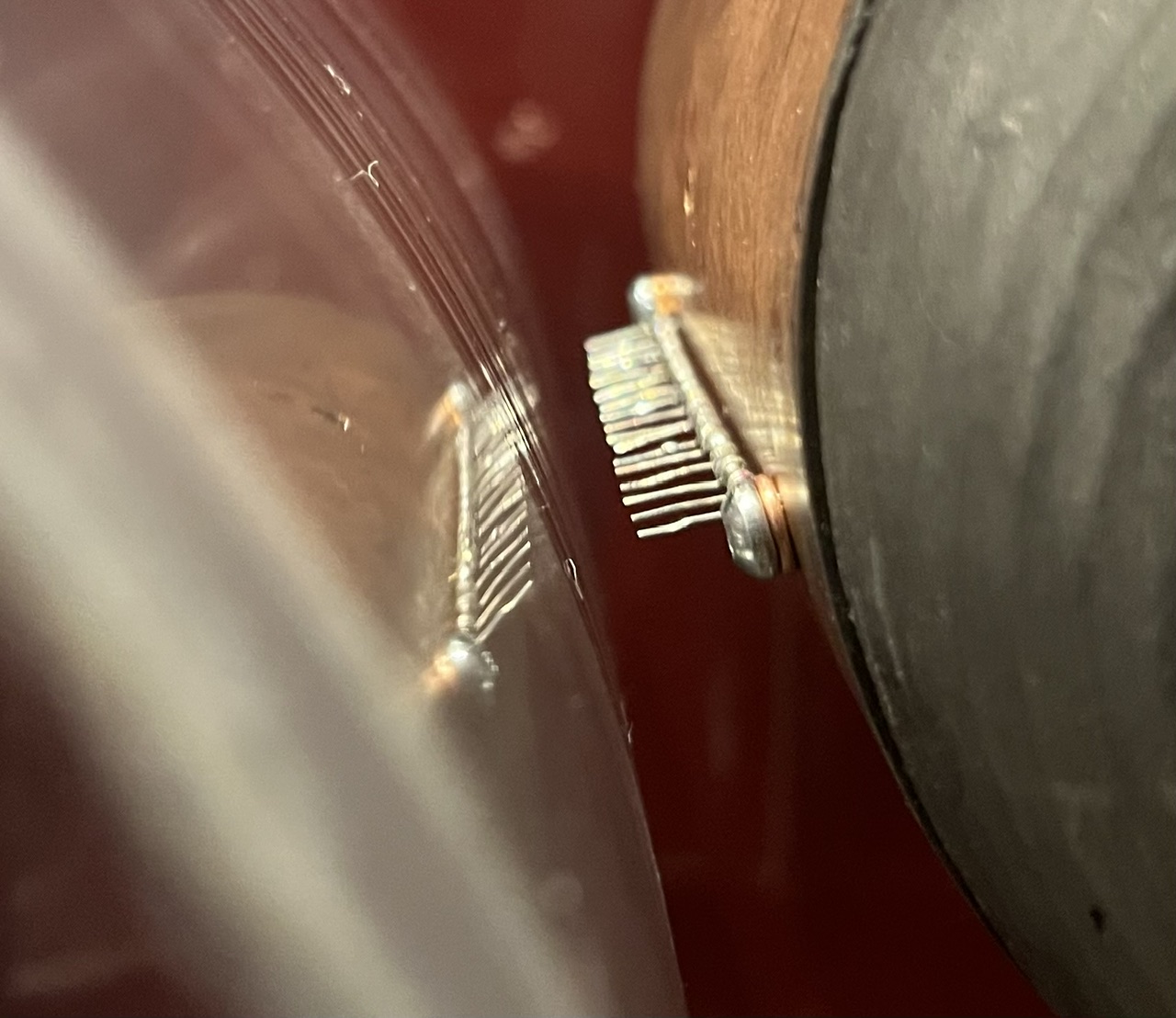 As the acrylic drum rotates, that charge soon finds itself in front of the comb-like structure attached to the electron collector. The extra electrons on the acrylic repel each other and take the opportunity to jump through the air to the comb and spread out on the surface of the copper drum. The points on the comb facilitate this process because their sharp features generate intense electric fields that can actually ionize the air creating a conducting plasma.
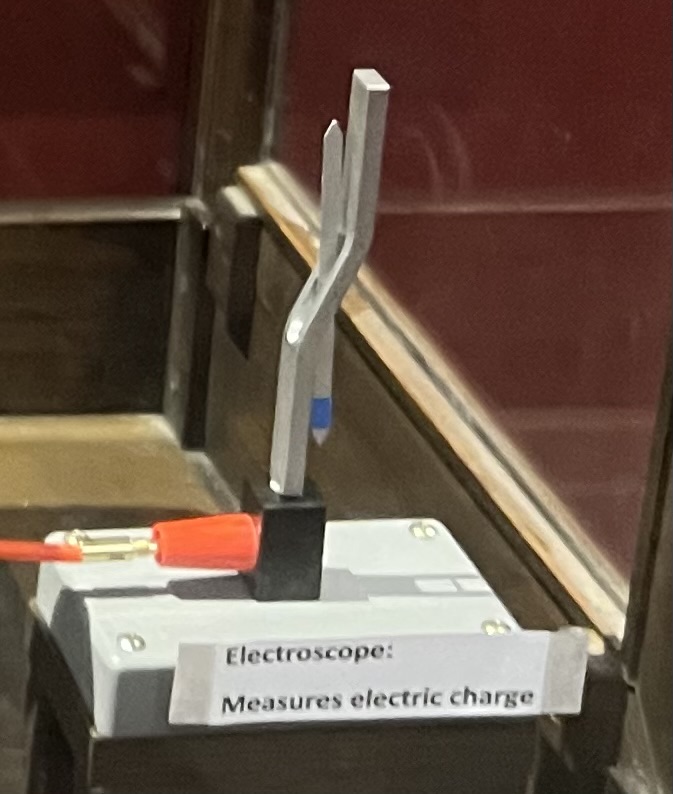 The electron collector is connected with a wire to a metal ball and also to an electroscope, which measures the accumulated charge. The electrons, because they repel each other, will try to spread out as much as possible. This results in a slight force on the movable arm of the electroscope. The arm is nearly perfectly balanced, having only a slight inclination to point downwards. The weak force from the electric charge causes it to rotate, creating an angular separation between it and the fixed vertical part of the electroscope. The more charge, the more the arm moves. The deflection will remain until the charge is dissipated, either by the visitors finger or by leakage of the charge to ground.
The blue dot at the end of the arm is actually a small piece of tape. The weight of that tiny piece of tape actually has a significant impact on the balance of the arm. By changing the amount of tape it is possible to adjust the electroscope's sensitivity to the electric charge.
The amount of charge is proportional to the voltage. While a common AAA battery has a voltage of only about 1.5 Volts, the voltage of the electron collector is typically several thousand volts. However, it's not dangerous because it only stores a very small amount of electric charge, which easily dissipated by a small spark to your finger.
You might wonder what happens when the pad has already transferred a lot of electrons to the drum. The loss of electrons causes the pad to develop a positive charge which inhibits the electron transfer. Over time, this charge will slowly leak to the cabinet or to ground. In order to expidite this process, the nylon cloth that forms the top layer of the pad has beneath it a conductive layer made of aluminized mylar. This is the same material used in emergency blankets. The aluminized side is conductive and faces outwards towards the nylon cloth which is just above it. It is connected with a wire to the cabinet, allowing an easy path for electrons to be restored to the nylon.
Related topics:
Surface conductivity
It turns out that one of the biggest problems with any exhibit or demonstration of static electricity is that the charge may find an electrical path to ground and disappear. This may happen along surfaces that are not perfectly clean, even though they may look clean. Most cleaning products, even ones recommended for acrylic plastic, fail to solve the problem. Some of these even include an antistatic agent as one of the ingredients, actually making the problem worse. However, washing thoroughly with a regular dishwashing liquid, such as Dawn, can successfully remove the contamination.
Humidity
Contrary to popular belief, pure water does not conduct electricity. Tap water, however, usually conducts fairly well because it typically contains a significant amount of dissolved solids, which broke up into conductive ions when they dissolved. When humidity is high, moisture from the air tends to form a thin film of water on surfaces which then becomes slightly conductive because of the contamination on that surface that can dissolve. This is why static electricity is not often experienced a humid day, but rather on a dry day, for example when you walk across a carpet and then touch a doorknob (zap!).
You may have noticed that the exhibit is all enclosed except for two holes large enough for your finger to enter. It used to be more open but it was found that the rotating drum would quickly get contaminated by contact with peoples hands and the exhibit would stop working. Now, with it more enclosed and well cleaned, it is able to work fine even on days with relatively high humidity.
Corona discharge
You may have noticed that the electron collector and the metal ball have relatively smooth features. This is by design, because the electric field tends to be strong at places where the surface is relatively sharp. Strong fields are to be avoided, because When the field gets sufficiently high, the air molecules will break down and cause "corona" discharge into the air, preventing the voltage from rising any further. Wires connecting the electron collector to the ball and the electroscope are covered with plastic insulation to prevent any discharge from the wires. Aside from this corona effect, there is relatively little conductivity directly through the air, as opposed to conduction along a surface, even on a very humid day. There is also very little conduction through the interior of the acrylic plastic as it is a good insulator. Although wood is a poor conductor for most ordinary purposes, the wood frame of the exhibit does conduct slightly and can be considered to be effectively "grounded" in regards to static electricity. You may even find that you can discharge the ball more thoroughly (as indicated by the electroscope) if you are touching the wood frame with your other hand when you touch the ball.
Corona discharge is a very important factor in high voltage power lines where it is a significant source of energy loss. Also, the insulators that contact the lines often have very convoluted surfaces to increase the surface path length and thereby decrease the conductivity.
Comparison to a Van de Graaff generator
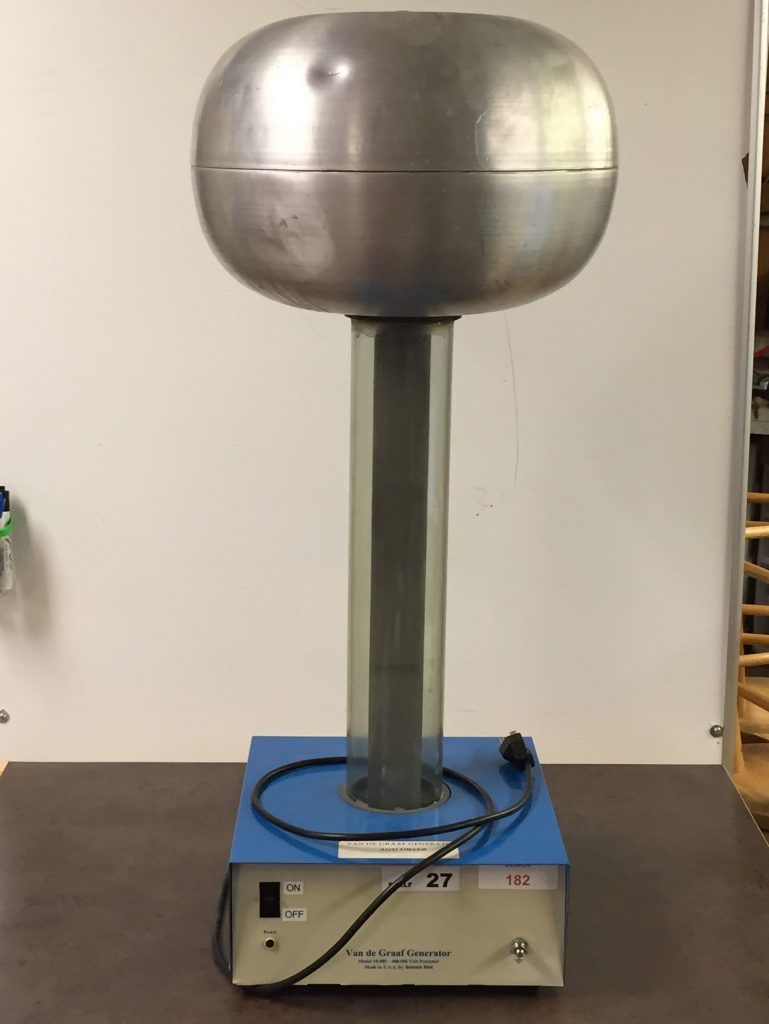
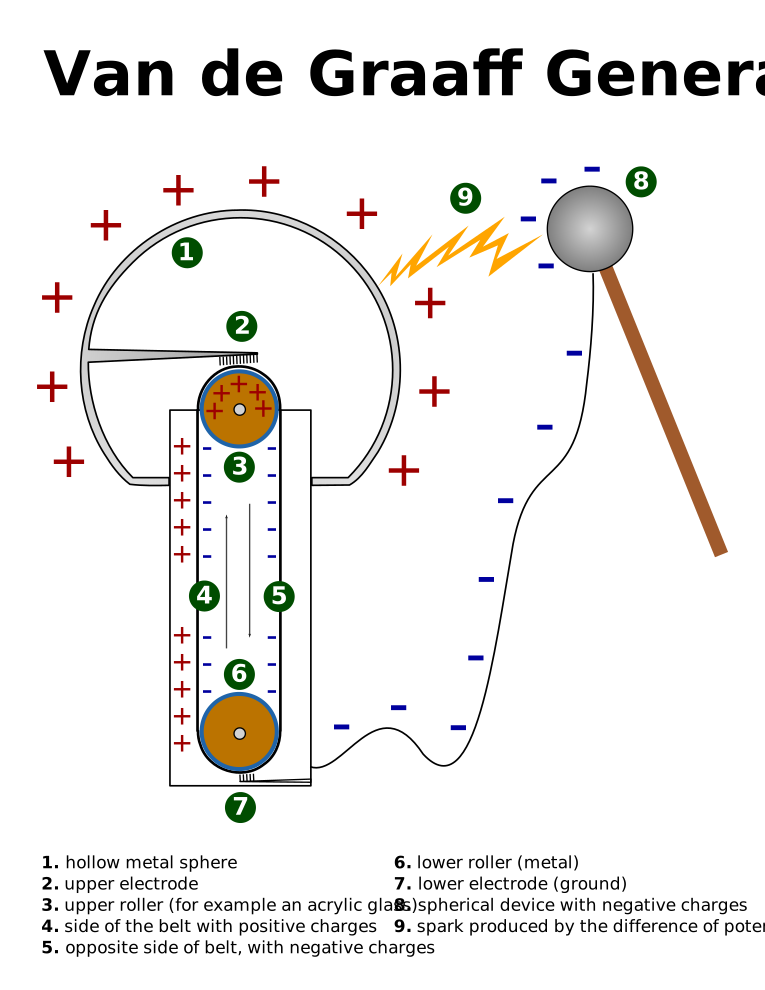 One very common device for producing static electricity is the Van de Graaff generator. Although the Fleet Center does not currently have one on display, it is nevertheless interesting to know how it works and how it is different from the rotating drum generator. It was invented by Robert Van de Graaff in 1929 for use in particle accelerators for high energy physics experiments. It is well suited to that purpose as it can generate exceedingly high voltages at relatively low current. The generator has the physical appearance of a mushroom cloud, with a central post going from the ground to a large flattened sphere at the top. In place of the rotating drum, it uses a belt loop on two rollers one at the bottom and one at the top, with the bottom roller being driven by a motor. The belt and the rollers are generally made of different materials so that there will be a triboelectric effect. A typical choice is to make the upper roller of nylon and the belt of latex rubber. The lower roller is sometimes metal and sometimes an insulator such as silicon. There are two combs, one at the bottom that transfers electrons from the belt to the ground and one at the top that transfers electrons from the flattened sphere to the belt. The rotating belt moves electrons from the top to the bottom.
One important distinction between the Van de Graaff generator and the rotating drum exhibit, is that the belt extends far into the interior of the sphere at the top. This is important because of a physics principle called Gauss' law. A result of this law is that when a metal object is charged with static electricity, the charge will reside entirely on the surface and there will be no electric field inside. Thus when charge is brought into the interior of the sphere on the belt, its natural tendency is to move to the surface of the sphere, even when the sphere is already charged to an entremely high voltage. By contrast, in the exhibit with the rotating drum, the electron transfer occurs on the outside of the electron collecting drum and that transfer is resisted by the electric field from charge previously transferred there, limiting the maximum voltage that can be achieved. Gigantic Van de Graaff generators have been built that can achieve voltages as high as 25 million volts. Small tabletop models can produce about 100 thousand volts.
A subtle complexity of the Van de Graaff generator is that the belt loop can collect charge on both the inside and the outside. The inside contacts the rollers and thus experiences the triboelectric effect, but the exterior of the belt actually transfers the charge from the bottom to the top. It works because the electric field from the charge on the inside penetrates the belt an affects the charge accumulated on the outide.
Lightning
Thunderstorms generate static electricity on an enormous scale. They also involve the triboelectric effect but now involving different particles colliding with each other and transferring electrons. For the usual form of lightning, the collisions are between two types of frozen water: tiny ice crystals and a soft form of hail called graupel. The ice crystals are moving upwards, caught in an updraft in the cloud, while the larger and heavier graupel is falling downwards or holding approximately still, since the updraft has less affect on them due to their larger size and weight. Due to subtle differences in the surfaces and temperatures the graupel tends to accumulate electrons, making the lower part of the cloud negative while the upper part of the cloud becomes positive. The voltage generated in thunderclouds can be from 100 million to 1 billion volts with currents during a strike typically 30,000 Amperes.